Articles & Case Studies
The Fallacy of Waterfall Enrichment
Waterfall enrichment stacks vendors that all buy the same LinkedIn data. You are not adding truth, you are adding back the records each vendor missed.

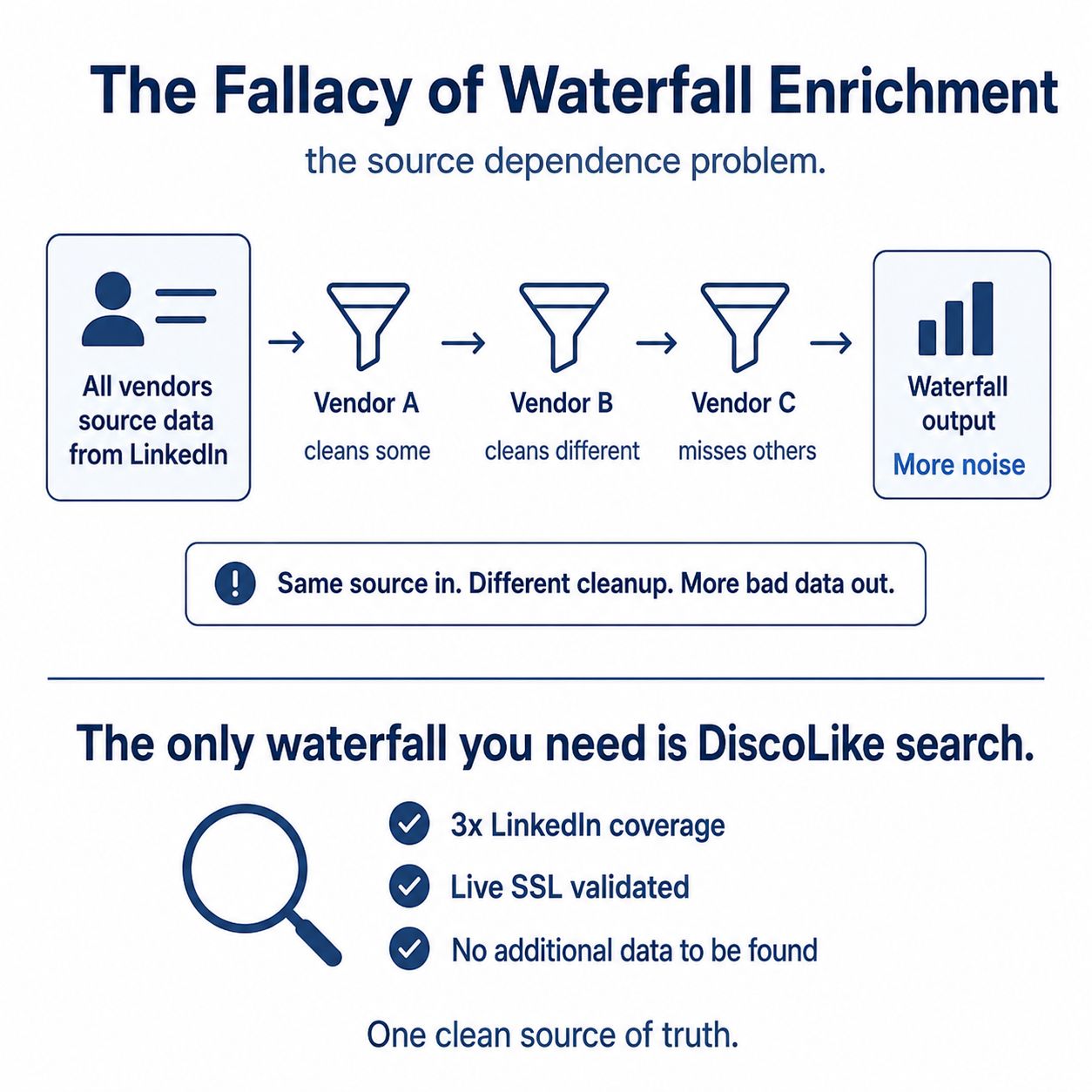
The fallacy of the waterfall enrichment: you are spending money to make your list worse.
This is the same weak source dependence problem. Waterfall enrichment assumes each vendor is an independent source. But if all vendors are copies of the same original source, the waterfall does not add truth. It adds back the records each vendor failed to clean.
Every Vendor Buys From the Same Source
While there are many company and contacts data providers that present themselves from different angles with different promises, they all buy data that comes from the same source: LinkedIn.
LinkedIn is noisy. Plenty of fake companies. Plenty of obsolete records. There is no real cleanup or garbage collection. LinkedIn tried to enforce validation many years ago. Then gave up a long time ago.
You have one vendor that got LinkedIn data and cleaned it up the best it could. You have another, cleaned a slightly different set, missed some others. And so on.
What a Waterfall Actually Adds
Now it is easy to see the problem:
Your waterfall enrichment simply adds bad records that each vendor missed. There is no new data to be had, it is the same source. The new records you get are the records each vendor did not remove.
Waterfall Enrichment for Contacts
Doing it for contacts? It is often the same. A person left the company. One vendor removed him. The next one did not. And you will happily add it as a waterfall record.
One Clean Source of Truth
You need one clean source of truth, and that is what DiscoLike is. Not based on LinkedIn, but on the internet fabric itself, validating companies through their SSL certificates, not free form LinkedIn entries anybody can add at any time at no cost.
The only waterfall you need is DiscoLike search. With 3x LinkedIn’s coverage and every record validated by a live SSL cert, there is no additional data to be found.
Except for the records others have not cleaned up yet.
Frequently Asked Questions
What is waterfall enrichment?
Waterfall enrichment is the practice of querying data vendors in sequence, moving to the next provider whenever the previous one returns no match. It assumes each vendor holds independent data, so stacking them raises coverage and accuracy.
Why doesn’t waterfall enrichment improve data quality?
Because the vendors in the waterfall are not independent sources. They mostly license the same underlying LinkedIn-derived data and clean it differently, so a fallback vendor rarely contributes new information. What it contributes is the records the earlier vendor deliberately removed as stale or fake.
How do SSL certificates validate a company record?
A live SSL certificate proves a company operates a real, currently reachable web presence, which is infrastructure a business has to maintain rather than a free-form profile anyone can create. DiscoLike builds its index from that network layer instead of LinkedIn entries, so validation is continuous rather than self-reported.
Should I stop using multiple data vendors entirely?
The question is not how many vendors you use, it is whether they draw on different primary sources. Stacking vendors that all resell the same source multiplies cost without adding truth, while a source-independent index gives you coverage the LinkedIn-derived layer never had.
Related posts: