Articles & Case Studies
How to Evaluate B2B Data Sources
Company websites are direct sources for business descriptions, while directories and aggregators contribute other information. Evaluate each field by its source, freshness, and relevance to the task.

· updated October 8, 2026
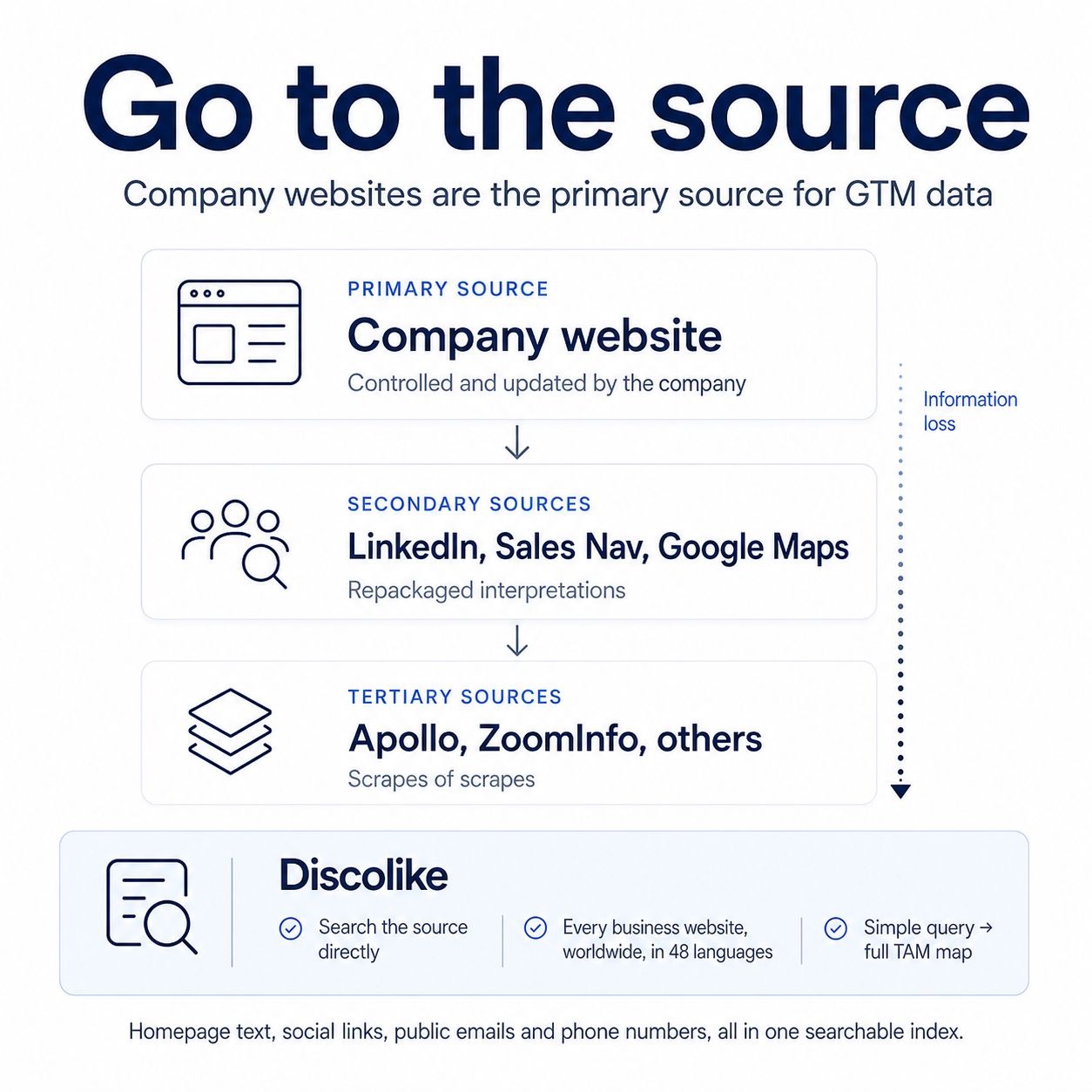
A company website often gives the clearest available account of what the business sells. Yet many GTM workflows start with a broad directory label, then spend time retrieving the website to recover the detail that label left out.
For account discovery, start by asking which source can support the decision you need to make.
Company websites: useful for business activity
Product pages, service descriptions, locations, and published customer examples can help establish whether a business fits your ICP.
These are company-controlled statements. They can be incomplete or outdated, and they are not independent proof of every claim. They are still valuable evidence of how the business presents its offering.
Directories and networks: useful for specific contexts
Professional networks may help identify roles and company affiliations. Maps services can help locate branches. Licensing or trade directories can add specialized records.
These sources contribute different views. They are not necessarily copies of the company website, and one source should not automatically override another for every field.
Aggregators: inspect the provenance
A data provider may combine licensed datasets, public sources, direct contributions, and its own research. Ask where a field comes from and how often it is checked.
Two providers can overlap heavily without being identical. A new provider adds value when it contributes verified records or fields your existing source lacks.
Match the source to the question
| Question | Evidence to inspect |
|---|---|
| What does the company sell? | Product and service descriptions |
| Is this the right location? | Address and branch information |
| Does this person still work there? | Current role and affiliation evidence |
| Is this a real new account? | Domain, organization identity, and CRM overlap |
Preserve the source and observation date where possible. A field without provenance is harder to challenge when it conflicts with another source.
How DiscoLike fits the workflow
DiscoLike discovers business domains using network signals and analyzes website content to build searchable company profiles. Natural language search, lookalike domains, and phrase matching help find companies whose activities match an ICP.
The same platform then handles ICP validation, account research, contacts, additional open-web discovery, email verification, and CRM sync. Each stage answers a different question: an active business record is not automatically a campaign fit, and a discovered contact is not automatically a verified email.
Test company discovery against a segment you know. Compare qualified new accounts, freshness, and cost rather than the raw size of each provider’s directory.
Related posts: