Articles & Case Studies

George Rekouts
Co-Founder & CEO
What Modern AI Search Actually Is
You are a GTM engineer, but very likely you cannot explain what modern AI search actually is. Fair warning: some technical material ahead. Do not click if you are expecting a Claude trick for 100 meetings a day.
AI Search Is Not One Thing
AI search is not a single method. The gold standard is a hybrid of keyword search and vector search. One constrains exact concepts, the other ranks by semantic similarity. Keywords keep the search grounded. Vectors find the closest matches inside that space.
Vector search turns text into embeddings, high-dimensional numerical representations, and compares them using cosine similarity. That is how the system retrieves meaning, not just exact wording. But meaning without constraints gets noisy fast.
Keyword search enforces precision. It ensures that specific terms, product names, certifications, or technical phrases appear in the results. Keywords alone do not understand meaning, but they prevent the search space from drifting.
Together, they are absurdly effective. Vector search finds what you mean. Keyword search makes sure you get exactly what you asked for.
The Hard Part Is Not the Retrieval Method
The hard part is writing the right text and selecting the right keywords so the system searches the right space. Small changes in wording change the result set more than most people expect.
A GTM engineer who writes “B2B SaaS companies selling to enterprise” will get a different result set than one who writes “mid-market software vendors targeting Fortune 500 IT departments.” Both describe similar markets. The embedding spaces they activate are meaningfully different.
This is where most GTM teams hit a wall. They understand their ICP intuitively but cannot translate that understanding into the precise text and keyword combination that activates the right search space. The gap between knowing what you want and writing a query that finds it is wider than anyone expects.
How the Outcome Learning Model Closes the Gap
DiscoLike’s Outcome Learning Model learns from the best prior searches. It works in two stages, each using the model best suited for the task.
Stage one: pattern extraction with Claude Code. Claude is strongest at structured analysis. It goes through thousands of successful TAM searches created by real GTM teams, extracts which ICP descriptions, keyword combinations, and search configurations produced the best results, and identifies patterns no single operator could see across the full population.
Stage two: query generation with GPT-5.3. GPT-5.3 is strongest at understanding business essentials and translating intent into natural language. With the extracted patterns as context, it generates the ICP text, keyword selections, and search parameters that maximize result quality.
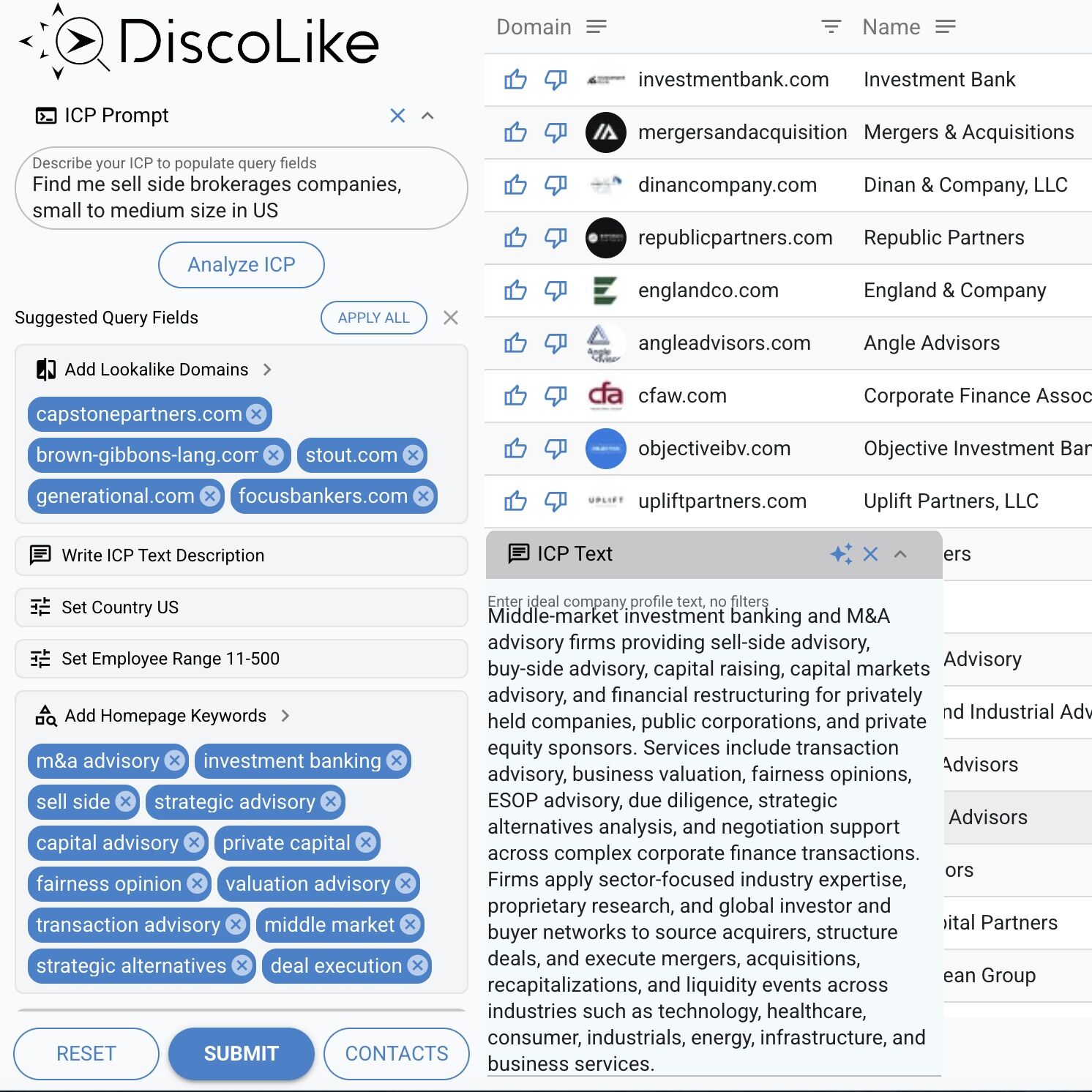
The result: you give DiscoLike one sentence, the rough ICP description that lives in every founder’s head, and the system returns a fully configured dense search vector with optimized keyword constraints, ready to return precise matches.
It Can Outperform Expert Manual Work
I have personally done a few thousand TAM searches. To my surprise, the Outcome Learning Model can now outperform some of my best manual work. Not because the underlying models are smarter than an experienced operator. They outperform because they have seen thousands of successful searches and can synthesize the best patterns from all of them simultaneously.
No single GTM engineer has done thousands of TAM searches across hundreds of different verticals. The model has. It knows which phrasing works best for healthcare versus fintech, which keyword constraints produce cleaner results for local services versus enterprise SaaS, and which combinations of vector text and phrase match yield the highest precision.
Why This Matters for GTM Engineers
Most GTM engineers build their search skills through trial and error. They iterate on queries, learn what works, and develop intuition over time. That process works, but it is slow and the knowledge stays locked in one person’s head.
The Outcome Learning Model compresses that learning curve. A new team member with zero search experience can now generate queries that rival what took senior operators months to learn, because the system learned from every successful search that came before.
This does not make GTM engineers irrelevant. It makes them dramatically more effective. The operators who understand what the system is doing, and can refine and override its suggestions when their domain expertise says otherwise, will pull even further ahead.
Frequently Asked Questions
What is hybrid search in AI?
Hybrid search combines vector search (semantic similarity via embeddings) with keyword search (exact term matching). Vector search finds results by meaning; keyword search constrains results to include specific required terms. Together they deliver both relevance and precision.
Why is query writing harder than choosing a search method?
The search method (vector, keyword, or hybrid) is a one-time engineering decision. Query writing happens on every search. Small changes in wording shift the embedding space and produce materially different results. Writing effective queries requires understanding both the target market and how the search system interprets language.
How does DiscoLike’s Outcome Learning Model improve search quality?
The Outcome Learning Model analyzes thousands of successful TAM searches from real GTM teams, extracts the patterns that produced the best results, and uses those patterns to generate optimized search parameters. It combines Claude Code for structured pattern extraction with GPT-5.3 for business-aware query generation.
Can the Outcome Learning Model replace a GTM engineer?
No. It compresses the learning curve and raises the floor for search quality, but domain expertise and judgment still matter. The strongest results come from experienced operators who understand the system and can refine its suggestions based on their specific market knowledge.
Run your best TAM search. Then run the same one through DiscoLike’s latest model. Let me know if it outruns you too.
Related posts: